In gum base procurement, form is often treated as a technical detail. Block, pellet, and sheet are usually discussed as if they are interchangeable. On paper, they more or less serve the same purpose. In actual production, the choice of form tends to matter more than people expect.
Sheet gum base is a typical example. It works well in some factories. In others, it causes extra trouble. This difference is not always obvious at the beginning, especially during early testing.
Sheet gum base is mainly used for harder gum bases and for formulations with higher softening points. Because it is thinner than block gum base, heat reaches the material faster. For automated production lines, this can be helpful. When feeding, softening, and mixing are aligned, sheet gum base usually enters the process more smoothly and needs less preparation.
That is one reason fully automated gum manufacturers often prefer sheet gum base. Still, this choice depends a lot on how stable the production environment actually is.
The thin structure of sheet gum base also makes it more sensitive outside the mixer. Compared with block gum base, it reacts faster to temperature and humidity. This becomes more noticeable during hot seasons. In summer transport, sheets may begin to soften earlier than expected, sometimes before they even reach the factory.
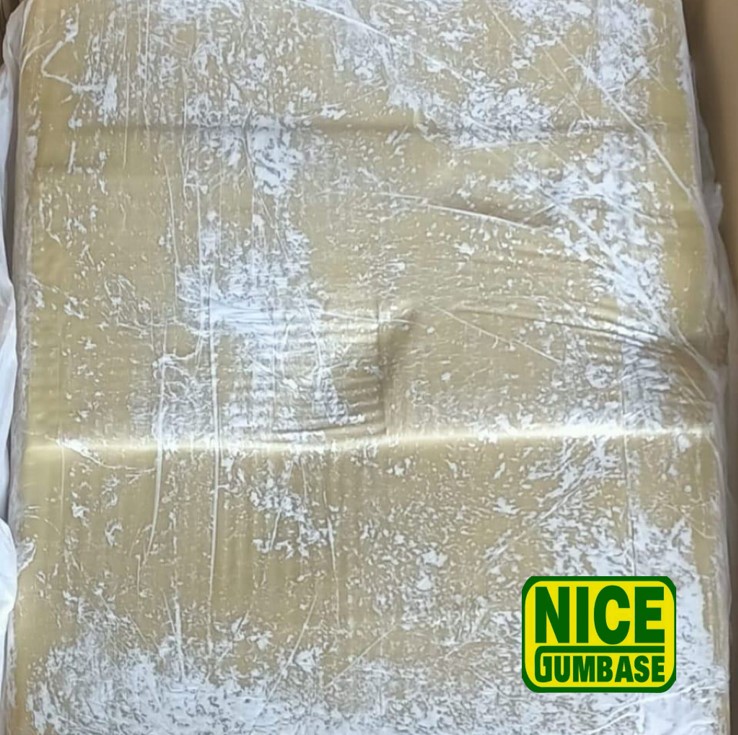
Once sheets start sticking together, handling becomes more difficult. If the bonding is light, operators can still separate them. If it becomes serious, the material no longer behaves like individual sheets. It turns into a thick mass, closer to block gum base, but without the same consistency. In that situation, the original reason for choosing sheet gum base is basically gone.
On paper, sheet gum base looks simple. Flat, thin, easy to handle. In reality, one detail matters more than most specifications: whether the sheets stay separated. If sheets partially stick together, they must be pulled apart by hand. This adds time and also adds variation.
Some sheets enter the mixer earlier. Some soften more. These differences are small, but they affect how evenly the gum base blends with other ingredients, especially in harder gum formulations. When texture problems appear, the formula is often blamed first, even though handling is often the real cause.
Sheet gum base works best when the production process is stable. Factories that benefit from it usually have controlled storage temperatures, predictable feeding and mixing sequences, and limited manual handling. Under these conditions, sheet gum base behaves as expected. In less controlled environments, its sensitivity becomes a disadvantage.
From a unit price point of view, sheet gum base often looks cheaper. However, experienced buyers usually do not look at price alone. If sheets stick during shipping, if storage conditions change, or if extra labor is needed to separate the material, the real cost increases quickly.
This is why some manufacturers move back to block gum base after trying sheets, even when the initial price seems attractive.
Instead of focusing only on data sheets, experienced buyers tend to ask more practical questions. How stable are the sheets during long-distance transport? What temperature range is realistic in daily operation? How consistent is sheet separation from batch to batch? These questions usually come from production experience, not from lab tests.
Sheet gum base is not just a thinner version of block gum base. It is designed for speed and automation, but it requires tighter control over temperature, storage, and handling. When those conditions are met, it works well enough. When they are not, the problems are hard to ignore.
Author: Wuxi Gum Base
Publication Date: 2/10/2026