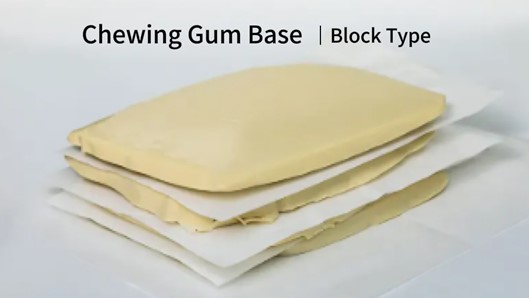
When people ask about chewing gum base, they usually care about performance.
Elasticity.
Flavor holding.
Sugar-free compatibility.
That makes sense.
But in real production, the form of the gum base matters a lot.
Especially when the gum base comes in thick blocks.
Many factories still use block-type gum base.
Not because they are conservative.
Mostly because it fits their situation.
Why Some Factories Choose Thick Gum Base Blocks

One reason is temperature.
In hot areas, storage is not always ideal.
Warehouses get warm.
Containers stay outside longer than planned.
Compared with pellets or thinner forms, thick blocks react more slowly to temperature changes.
They do not soften as fast.
They keep their shape better during transport.
Another reason is cost.
Among common gum base forms, thick blocks are usually the cheapest option.
The process is simpler.
Packaging is basic.
There is less handling loss.
For price-sensitive projects, this matters more than many people expect.
How Thick Gum Base Blocks Are Prepared Before Mixing
Thick blocks are not added directly into the mixer.
In most factories, they are softened first.
Usually in an oven.
The block is heated until it becomes flexible.
Not melted.
Just soft enough to work with.
After that, the block is cut.
Then it is added together with other raw materials.
If this step is rushed, problems appear.
Cold blocks take longer to mix.
Overheated blocks are hard to handle.
Both situations affect texture later.
This oven step is one of the reasons why some factories stay with block-type gum base.
They are used to this process.
Thickness and Cutting Make a Difference
Thickness is not just a visual detail.
Thicker blocks soften more slowly.
Thinner pieces soften faster.
If cutting size changes from batch to batch, mixing behavior changes too.
Some parts become plastic early.
Others stay firm longer.
Over time, this creates small differences.
Not always obvious.
But noticeable in production.
Factories that work well with thick blocks usually keep things simple:
- same block thickness
- similar cutting size
- same feeding order
Nothing complicated.
Just consistent.
Where Block-Type Gum Base Fits Best
Thick gum base blocks work best in:
- batch production
- semi-manual lines
- factories with oven pre-heating
They are less suitable for fast, fully automated lines.
This is not about old or new.
It is about matching the material to the process.
Conclusion
Thick chewing gum base blocks are still used for clear reasons.
They are more stable in warm conditions.
They cost less.
They fit oven-based preparation and batch mixing.
When thickness, heating, and cutting are controlled, block-type gum base works reliably.
That is why some factories continue to choose it.
Author: Wuxi Gum Base
Publication Date: 1/27/2026